
- Football News
- Transfer Updates
- Football News
- Transfer Updates
Gymnastics Celebrity News“The Weight of a Nation: Simone Biles Breaks Her Silence on Pressure, Pain, and Redefining Greatness”
Peter GraceJanuary 24, 20263 Mins read

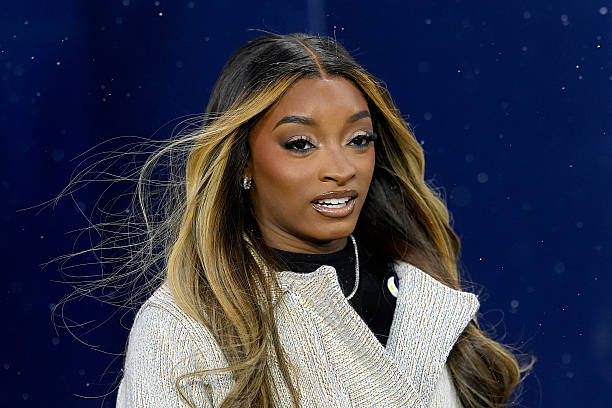
When Simone Biles speaks, the sports world doesn’t just listen—it pauses. On January 23, 2026, she didn’t step onto a competition floor or stand beneath blinding arena lights. Instead, she sat down across from another icon, Mikaela Shiffrin, on the podcast What’s the Point. What followed wasn’t a soundbite, a headline grab, or a polished motivational quote. It was something far rarer: an honest reflection from two athletes who have carried the weight of a nation and lived to explain what that weight really costs.
This conversation wasn’t about medals. It was about survival.
When You Become the Symbol
Both Biles and Shiffrin know what it means to stop being “an athlete” and start being “the face.” The phrase sounds glamorous until you live inside it. On the podcast, they spoke candidly about how representing Team USA gradually transformed from an honor into an invisible pressure that followed them everywhere—training halls, hotel rooms, and even moments meant for rest.
Biles described how expectations became louder than her own thoughts. Every routine, every appearance, every decision felt like it belonged to the public. Success wasn’t just winning—it was fulfilling a narrative written by millions. Failure, on the other hand, felt unforgivable, even when the body and mind were screaming for help.
Shiffrin echoed that reality from her own Olympic journey. She reflected on how the label of “guaranteed gold” quietly eroded her relationship with competition. When winning becomes assumed, anything less feels like letting everyone down—even when no one says it out loud.
Tokyo and Beijing Changed Everything
The Tokyo and Beijing Games marked turning points for both athletes, not just professionally, but personally. On the podcast, Biles spoke about how Tokyo forced her to confront the difference between external expectations and internal well-being. For the first time, she allowed herself to choose safety and mental health over applause.
What made this reflection powerful wasn’t defensiveness—it was clarity. Biles didn’t frame her decision as courage or weakness. She framed it as necessary. The Games stripped away illusions she had carried since childhood: that pushing through pain is always noble, and that greatness requires silence.
Shiffrin shared how Beijing reshaped her understanding of failure. She spoke about standing at the start gate knowing the world expected dominance, yet feeling disconnected from the version of herself that once thrived on that pressure. The experience forced her to redefine what success meant when victory no longer felt like joy.
Together, their stories revealed a shared truth: the Olympics didn’t break them. They revealed what was already fragile.
Redefining Success in Public View
One of the most striking moments of the conversation came when both athletes admitted that success now looks radically different than it once did. Gold medals still matter—but they no longer define worth.
Biles reflected on how stepping back allowed her to reclaim ownership of her career. Instead of asking, “What do they expect from me?” she began asking, “What do I need?” That shift didn’t come easily. It came with criticism, misunderstanding, and relentless scrutiny. But it also came with peace.
Shiffrin described a similar evolution. She spoke about learning to separate her identity from outcomes and how freeing it felt to compete without carrying an entire nation on her shoulders. For the first time, she allowed herself to be human before being heroic.
The Cost No One Sees
The podcast peeled back the polished image of elite athletics to expose the emotional toll rarely acknowledged. Biles and Shiffrin discussed loneliness, isolation, and the quiet fear of disappointing people who have never met you but feel entitled to your perfection.
They talked about how pressure doesn’t disappear when the competition ends—it lingers, shaping self-worth and decision-making long after the cameras shut off. For young athletes listening, the message was clear but unspoken: glory is expensive, and the bill often arrives later.
Why This Conversation Matters
This wasn’t just a podcast episode. It was a cultural moment. Two of the most dominant athletes of their generation sat down not to celebrate dominance, but to question it. In doing so, they challenged the outdated belief that mental toughness means emotional silence.
Their honesty didn’t weaken their legacies—it deepened them.
By speaking openly, Biles and Shiffrin reframed what it means to represent a country. It’s not about being flawless. It’s about being resilient, self-aware, and brave enough to evolve.
In a world that still demands superheroes, their conversation offered something far more powerful: permission to be human.
Related Articles
“She Didn’t Just Support Her Husband—She Set the Internet on Fire With One Post”
On January 29, what began as a simple social media post quickly...
“The World Is Watching Houston: Why Simone Biles’ 2026 Invitational Could Change Gymnastics Forever”
International Invitational: When Simone Biles Hosts the Future of Gymnastics In January...
She Faced a -20° Wind Chill for Love: Simone Biles’ Chicago Nights Are Melting the Internet
Headline Option 1:She Faced a -20° Wind Chill for Love: Simone Biles’...
“She Stole the Show in the Cold: Simone Biles’ Viral NFL Moment No One Saw Coming”
She Stole the Show in the Cold: Simone Biles’ Viral NFL Moment...
- Transfer Updates
- Transfer Updates



























Leave a comment